


Why Aging in Place Matters: Statistics and Personal Stories
Autonomy, freedom of choice, and the powerful case for aging on your own terms.
Every July, Americans celebrate their independence. For seniors, the spirit of independence takes on a deeply personal dimension: the right to remain in the home they know, the neighborhood they love, and the life they have spent decades building. Aging in place is not simply a preference. For the vast majority of older Americans, it is a defining priority.
The numbers reflect this clearly. According to AARP, nearly 90 percent of adults over the age of 65 want to remain in their current home as they age. Despite this near-universal preference, many families wait until a crisis (a fall, a hospitalization, a sudden decline) before taking steps to make that goal achievable. The result is reactive decision-making under pressure, rather than the thoughtful planning that makes long-term independence genuinely sustainable.
The stories behind those statistics are what give them meaning. Consider Dorothy, 78, a retired schoolteacher in Ohio who lived in the same house for 44 years. After a knee replacement, her adult children began quietly researching assisted living facilities. Dorothy had a different vision. “This is where I raised my children. This is where I want to grow old,” she told them. A few targeted modifications (including a Transfer Master adjustable bed) that made her post-surgical recovery manageable at home, and Dorothy never needed the assisted living facilities. Three years later she is in her home, active, and independent.
Stories like Dorothy’s are typical when families choose proactive plans. Aging in place is achievable for more people than conventional assumptions suggest, but it requires intention, the right conversations, and the right tools.
Planning Ahead: Conversations With Family About Long-Term Independence
A clearly expressed vision of what aging well looks like, and what they need to achieve it is one of the most important conversations a family should have with each other. These conversations are among the most avoided in family life. Adult children worry about seeming presumptuous. Parents worry about appearing vulnerable. So, the conversation waits, often until circumstances force it in the worst possible moment.
The best time to talk about long-term independence is now! While your health is stable, options are plentiful, and decisions can be made thoughtfully rather than urgently. Begin by articulating your own priorities. What matters most to you about your living situation? What needs to change for you to consider leaving your home? What modifications or tools will make staying home safer and more comfortable? Answering these questions for yourself before the conversation begins gives you a foundation to speak from with confidence.
When you sit down with family members, frame the conversation around your values, not your limitations. Rather than “I’m worried about falling,” try “I want to stay in this house for the next twenty years, and here’s what I think I’d need to make that happen.” This positions you as the author of your own future—someone making proactive choices—rather than a problem to be solved.
Include practical specifics. Discuss which home modifications might be worth exploring, what assistive equipment can support your daily routine, and what role—if any—you’d want family members to play in your care. Having a named list of preferences, including the types of products you’ve researched, signals seriousness and gives family members something concrete to support rather than an open-ended worry to manage.
These conversations are not one-time events. Revisit them annually, or whenever your health or living situation changes. The families who navigate aging in place most successfully are those who treat it as an ongoing dialogue—not a crisis to be resolved, but a chapter of life to be planned together.
Financial Benefits of Home Modifications vs. Facility Care
One of the most compelling, and least discussed, arguments for aging in place is the financial one. The cost of residential care in the United States has significantly risen to sobering numbers in recent years. The median annual cost of a private room in a nursing home now exceeds $100,000. Assisted living facilities, while generally less expensive, still average well over $50,000 per year nationally with costs in major metropolitan areas running higher.
Against those figures, the cost of meaningful home modifications looks remarkably modest. A comprehensive home safety assessment and modification package (including bathroom grab bars, improved lighting, stair railings, and bedroom safety upgrades) can typically be completed for a few thousand dollars. An investment in a quality adjustable bed system, one of the most impactful single modifications for bedroom safety and sleep health, represents a fraction of a single month’s assisted living cost.
The math becomes more compelling when you factor in timeline. The cumulative savings compared to facility care can reach hundreds of thousands of dollars for someone who remains at home safely for five additional years due to thoughtful modifications and the right equipment.
There are also financial tools available to help offset modification costs. Many states offer home modification assistance programs for seniors. The federal Older Americans Act funds local Area Agencies on Aging that connects individuals with grant programs and low-interest loans for accessibility improvements. Some long-term care insurance policies cover home modification costs directly. Veterans may have access to additional assistance through VA programs. Exploring these resources before making decisions can significantly reduce out-of-pocket expenses—making a strong financial case for aging in place.
The bottom line is straightforward: in most cases, investing in home modifications and quality assistive equipment is not just the emotionally preferable choice—it is the financially sound one. Planning ahead transforms what might feel like an expense into what it truly is: a long-term investment with measurable returns.
Spotlight: How Transfer Master Beds Are an Investment in Long-Term Independence
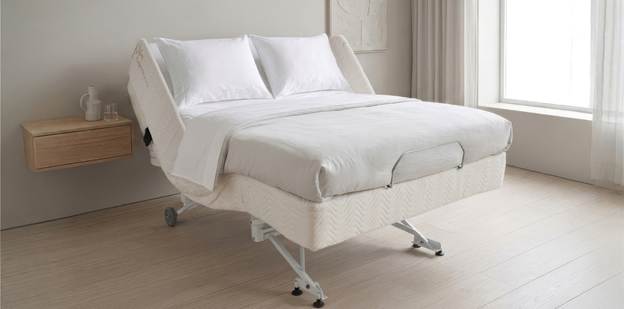
Evaluating the tools that make aging in place genuinely sustainable, the bedroom consistently emerges as the highest-priority space. It is where the day begins and ends, where recovery happens, and where some of the most physically demanding transitions of daily life occur. A bed that supports these transitions safely and comfortably is not a bedroom “accessory.” It is a foundational piece of long-term independence infrastructure.
Transfer Master beds are built with this understanding at their core. Every design decision (from the range of height adjustment to the engineering of the articulation system to the placement and grip of the side rails) reflects decades of working with aging adults, individuals with disabilities, and the families and caregivers who support them. The result is a bed system that accommodates aging in place while actively enabling it.
The return on investment is measurable. Consider the risk reduction alone: falls are the leading cause of injury-related death among adults over 65, and the bedroom is among the highest-risk environments in the home. A Transfer Master bed allows a user to rise slowly, supported, at the ideal height, with a secure rail to hold. It eliminates many of the most common conditions that precede a bedroom fall. Preventing a single serious fall, with its associated hospitalization, rehabilitation, and potential long-term care costs, can justify the investment many times over.
The quality-of-life value compounds over time. Better sleep, more comfortable rest, easier morning routines, and reduced caregiver burden contributes to a higher overall standard of living. A person who wakes rested, rises safely, and moves through their morning with confidence is a person who stays engaged, active, and home.
Transfer Master also offers the durability that makes a long-term investment meaningful. These are not consumer-grade products with a two-year lifespan. They are medical-grade bed systems engineered for heavy daily use over many years, backed by warranties, and supported by a customer service team that understands the stakes involved in every purchase.
This July, as the nation celebrates independence, Transfer Master celebrates the quiet, daily independence of every person who chooses to invest in their right to age at home and found that the right bed made that choice a lasting one.
Independence is more than a word on a holiday. It is a daily choice, a family commitment, and a goal worth planning for with the same care and intention you bring to everything else that matters in your life. Transfer Master is honored to be part of that plan, and proud to support your freedom to age exactly where you belong: at home.